

TROUBLED COMPANY INDEX®
The Troubled Company Index ® measures the percentage of 42,500 public firms in 76 countries that have an annualized one-month default risk of over one percent.
HJM++© Correlated Government Yield and Foreign Exchange Rate Simulations for Asia-Pacific, Europe and North America, October 23, 2026
The Heath, Jarrow and Morton [1992] framework for simulation and valuation using risk-free interest rates has been called “the most important paper in financial economics in the last 50 years.” The Center for Applied Quantitative Finance provides the risk-neutral and...
SAS Weekly Treasury Simulation, October 23, 2026: Probability of 3-Month Bill Yield Over 4% in One Year Up 7% to 68%
Summary The probability that the yield on 10-year U.S. Treasuries is over 5% in one year is down4% to 36% today. The probability that the 3-month Treasury bill rate is over 4% in one year rose 7% this week to 68% today. The most likely range for 3-month bill yields in...
HJM++© Correlated Government Yield and Foreign Exchange Rate Simulations for Asia-Pacific, Europe and North America, October 16, 2026
The Heath, Jarrow and Morton [1992] framework for simulation and valuation using risk-free interest rates has been called “the most important paper in financial economics in the last 50 years.” The Center for Applied Quantitative Finance provides the risk-neutral and...
SAS Weekly Treasury Simulation, October 16, 2026: Probability of 3-Month Bill Yield Over 4% in One Year Now at 61%
Summary The probability that the yield on 10-year U.S. Treasuries is over 5% in one year is at 40% today. The probability that the 3-month Treasury bill rate is over 4% in one year is 61% today. The most likely range for 3-month bill yields in 10 years remained at the...
HJM++© Correlated Government Yield and Foreign Exchange Rate Simulations for Asia-Pacific, Europe and North America, October 2, 2026
The Heath, Jarrow and Morton [1992] framework for simulation and valuation using risk-free interest rates has been called “the most important paper in financial economics in the last 50 years.” The Center for Applied Quantitative Finance provides the risk-neutral and...
AI Credit Risk Dashboard Update
Neocloud credit risk has increased materially since our September dashboard launch, but modeled default probabilities remain below distressed levels. The latest dashboard update reinforces the distinction we made at launch: rising risk in specialist AI infrastructure...
Introducing AI Credit Pulse Index
The AI infrastructure buildout is a credit theme that extends beyond the technology sector. Computing capacity depends on advanced semiconductors and servers, along with data centers, electrical equipment, cooling systems, fiber networks, construction services and...
The Growing Divide in High Yield
The quality of the public high yield market has improved over the past several years, at least by conventional ratings measures. A larger share of the public high yield market is now rated BB, while some of the riskier corporate borrowing activity has increasingly...
Update to Regional Credit Risk Analysis
Two months ago, we examined the impact of the Iran war on corporate credit risk forecasts around the world. The analysis showed that after the initial jump in March, most markets retraced much of the move by April. Out of 9 countries examined, Japan, Qatar, and Korea...
The SaaSpocalypse Impact on Credit
For much of 2026, one question has dominated the technology sector: what happens to traditional software companies when artificial intelligence can write code, automate workflows, and allow customers to build applications themselves? The resulting concern manifested...
ANALYTICS

KRIS Default Probabilities versus Credit Ratings

SAS Daily Bond Performance Attribution
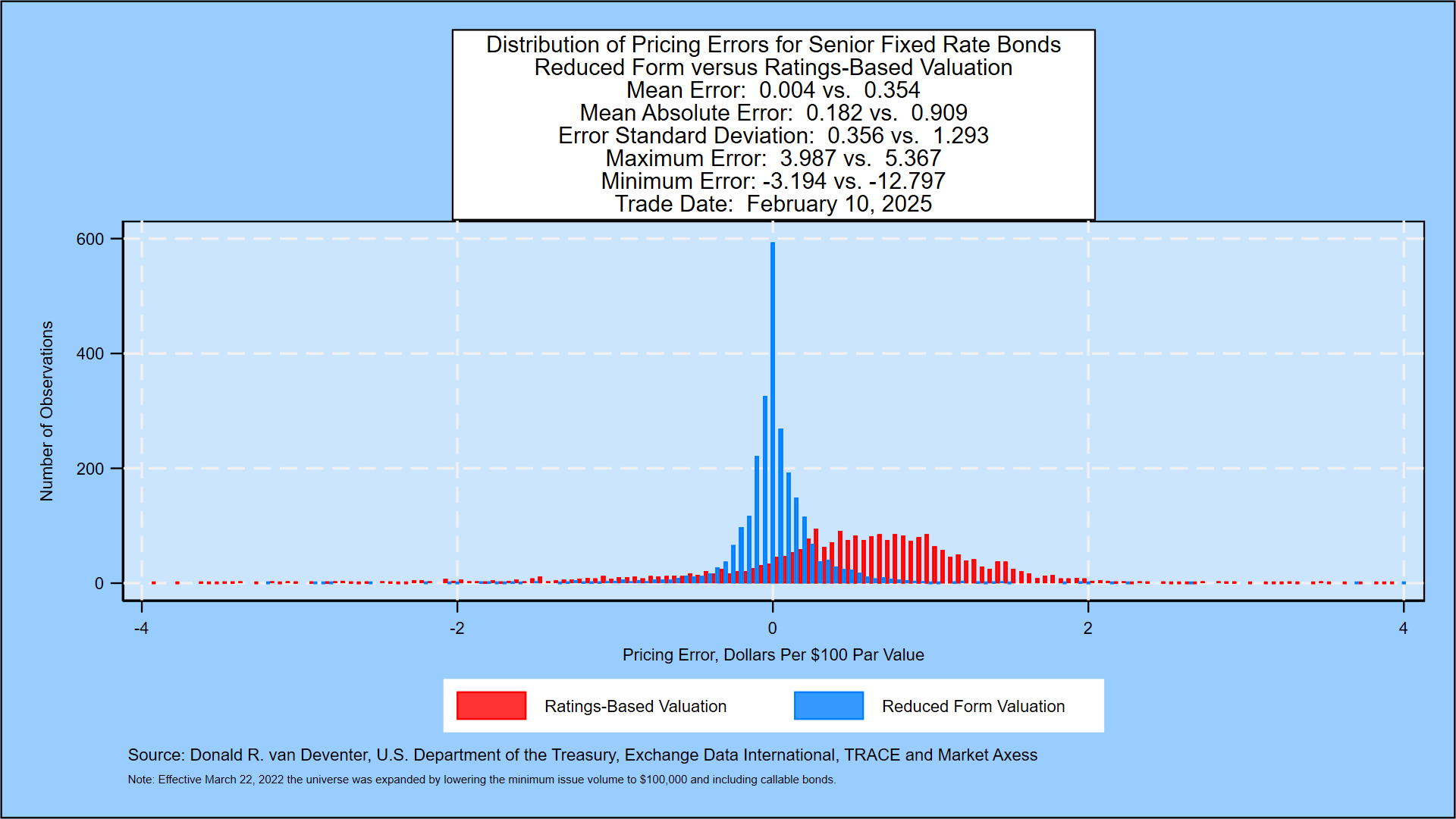
KRIS Daily Default Probability and
Bond Cross-Validation
EVENTS
- November
- 16 – 19 NOVEMBER | Quant Minds